Everything a back room holds.
Write to each person. The board keeps track.
Invite collectors before a fair or a show with a letter each. As people reply or go quiet, the board moves them along by itself and tells you when it is time to follow up.
- 1Invitations for the fair.
- 2The people who follow the artist are suggested.
- 3Write once. Each person gets their own link to the works.
- 4Each letter goes to one person.
- 5The board shows whose turn it is.
What every artist is owed, at a glance
Every paid sale writes the artist's share by itself. One card per artist shows what is owed and for which works, so the next step is plain: send the statement, they sign, you pay.

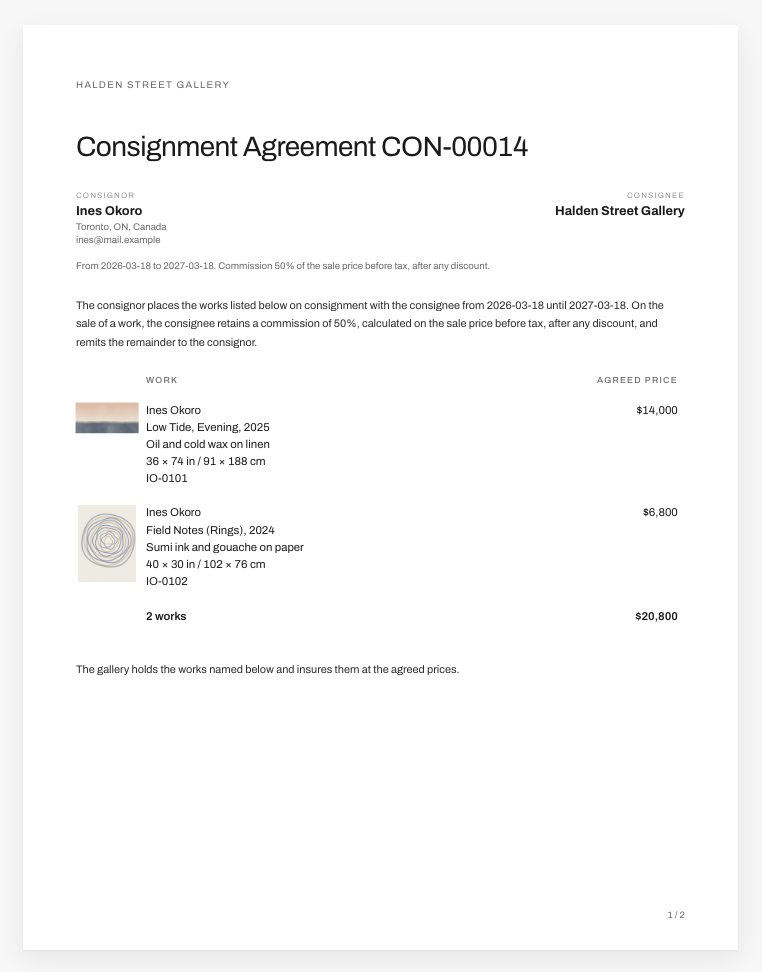
Agreements, written and signed
Pick the works and the agreement writes itself, with their sizes, prices, dates and split. The artist opens it as the page it prints on and signs on any screen. You see which are signed, which end soon and which works are still out.
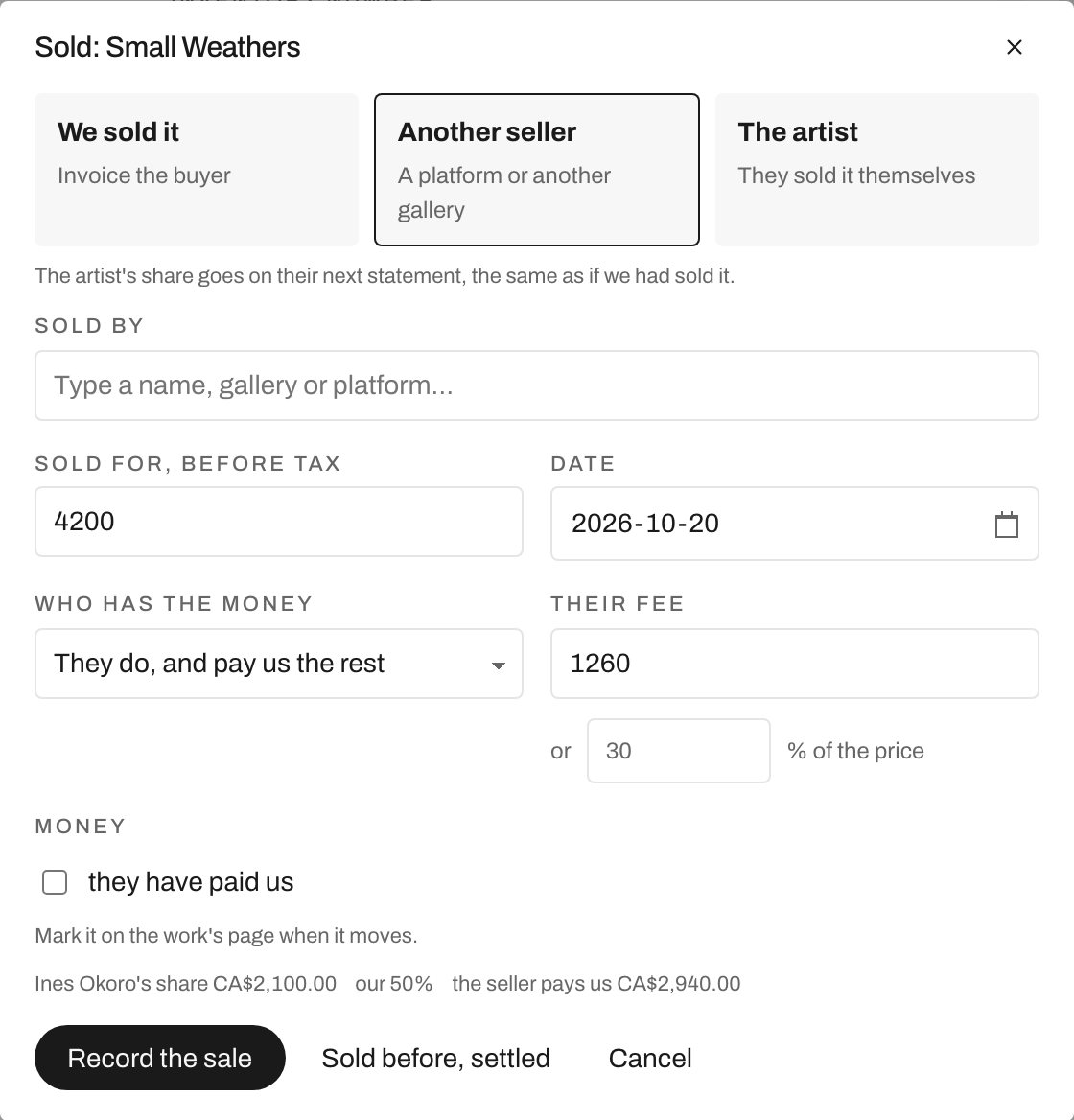
Mark it sold once
Buyer, price and payment in one window. The invoice, the receipt, the artist's share and the certificate follow, and Home shows what each sale still needs.
- 1Mark it sold: buyer, price, paid or not.
- 2The invoice writes itself.
- 3Home shows what the sale still needs.
Change it once
Add a show to an artist's record or change a price, and your price lists, the CV a collector opens from your link and its PDF all follow, and so does your website when it runs on Back Room.
- 1Add the show to the artist's record, once.
- 2The CV already lists it, on screen and in its PDF.
Ready for the fair
Hang the booth to scale from the works you choose, print the packing list from the same list, and sell on the floor from any screen.
- 1Give each work a wall.
- 2The whole booth shows it at once.
- 3Add another: the wall spaces itself.
Sold through another seller
When a platform or another gallery sells a work, record the deal once with their fee. The artist's share and what each side owes are worked out, and one statement, signed by both, settles it.
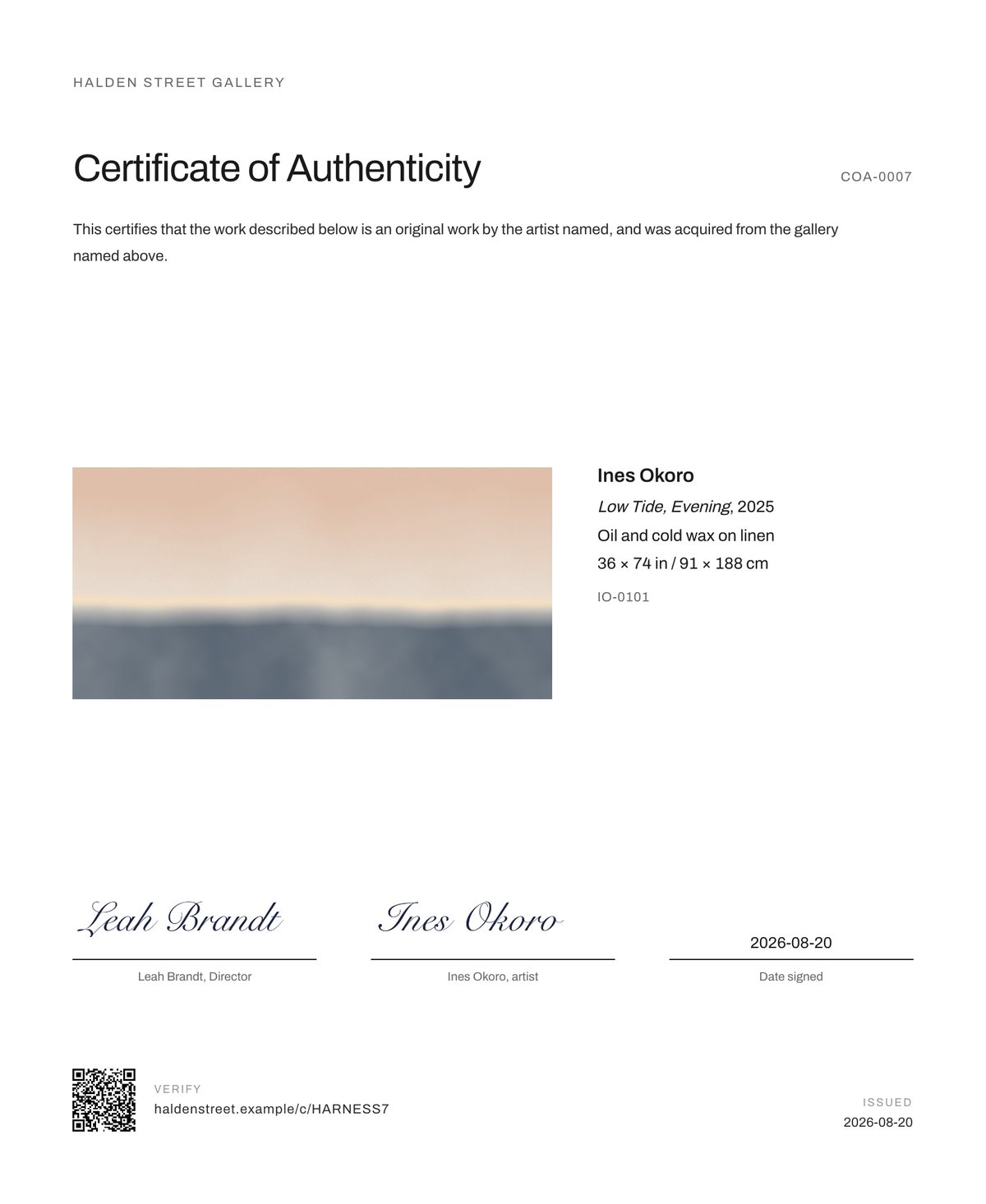
Certificates that prove themselves
One for each work or edition number, signed on screen and sent to the buyer. A code on the paper opens a page that confirms it.
Books that keep themselves
Every sale, payment and payout lands in the books on its own. Add every other cost with its receipt, from a fair’s booth fee to new lights or a renovation, so the books are up to date all year, and your accountant gets one package at the end of it. An add-on, from US$20 a month.
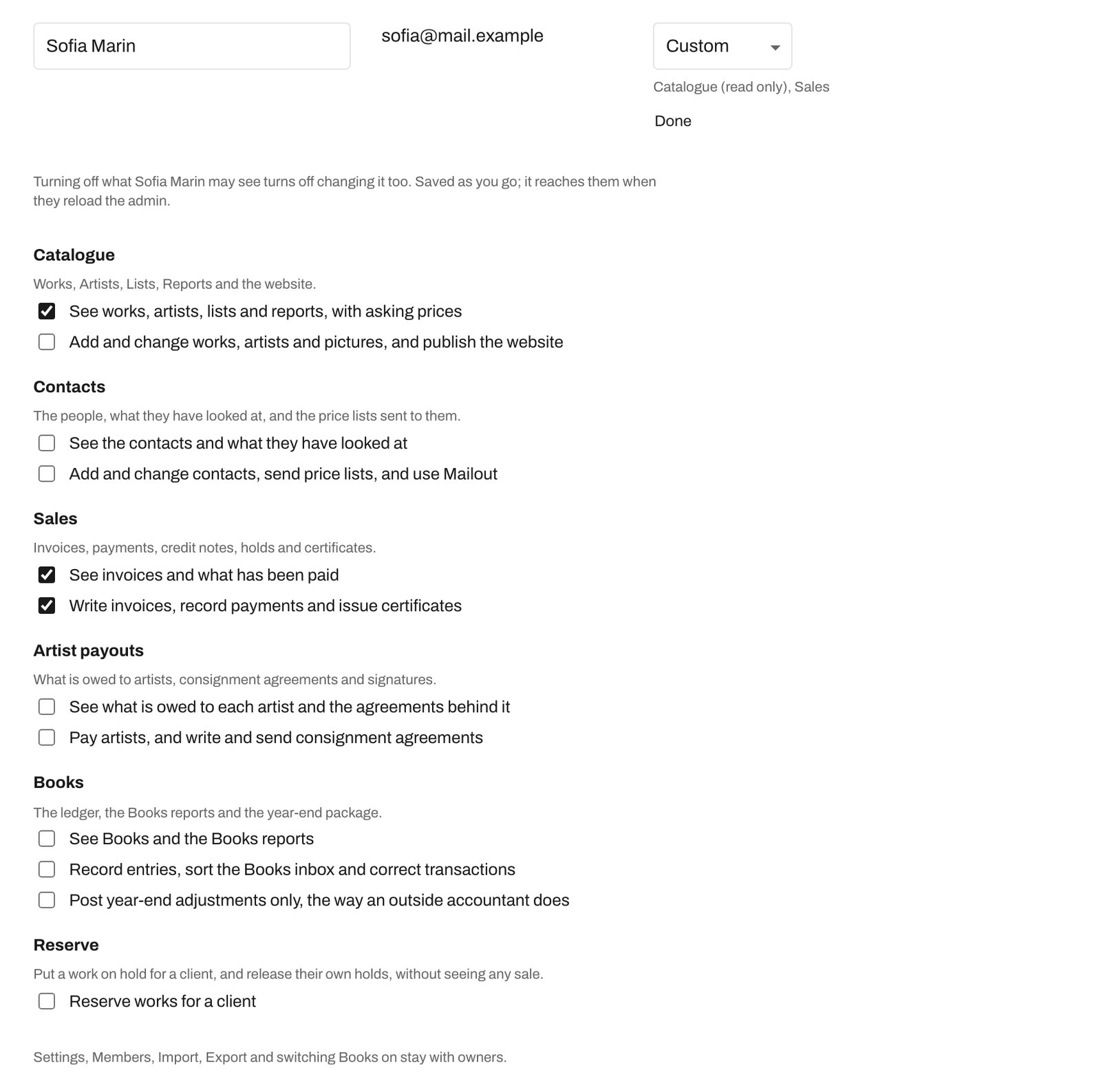
Each person, their part.
Start from a role, or set each switch yourself: what every person may see and change, area by area, down to reserving a work for a client.
| Owner | Everything, the settings and the team included |
| Manager | Everything but the settings and the team |
| Sales | Works, contacts and invoices; not what artists are paid, not the books |
| Registrar | Works and pictures; sees contacts and invoices without changing them |
| Accountant | The books, and nothing else |
| Read only | Works with their asking prices, and contacts; changes nothing |
| Your own mix | Any of the six areas, to see or to change, one person at a time |